
Nutrition Facts Template Free
Build a Nutrition Facts label in the current US layout from your own nutrient figures. Enter the serving size, servings per container and nutrient amounts per serving; the template rounds values using FDA rules, calculates % Daily Value, and draws a clean label you can print or save as an image-ready PDF.
- Free to use
- No sign-up
- Runs in your browser
Nutrition Facts label maker
Nutrition Label Template Pack
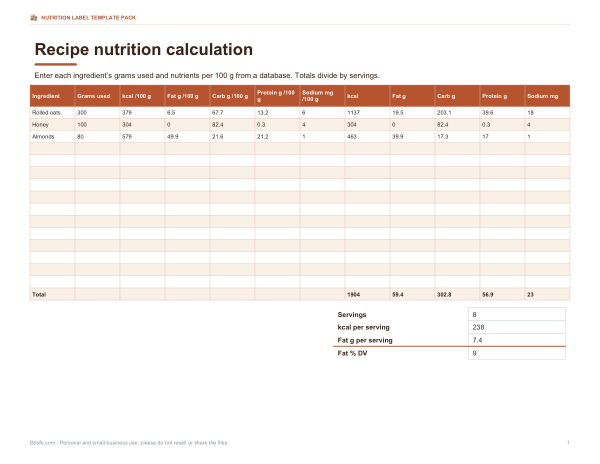
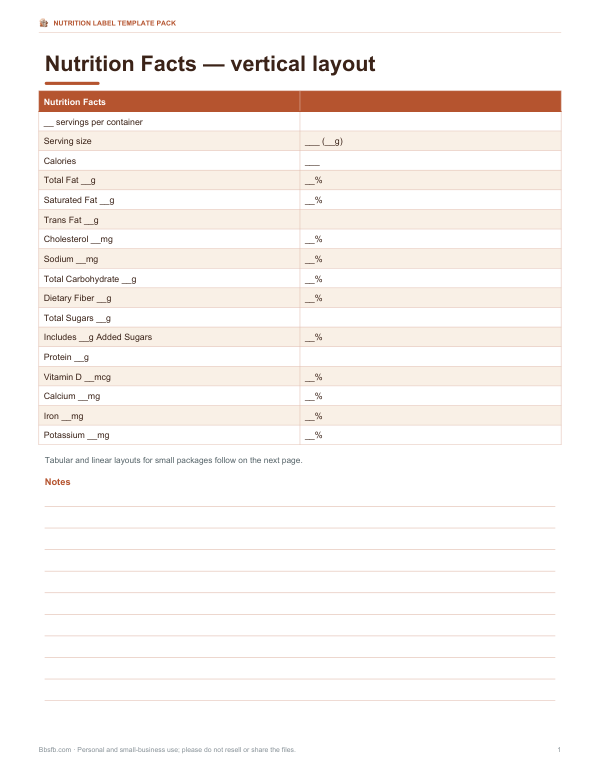
Editable Nutrition Facts templates (vertical, tabular, linear and dual-column), a recipe nutrition calculation workbook with DV formulas and a labelling checklist.
- Recipe nutrition workbook (XLSX)
- Label layouts (DOCX, PDF)
- DV & rounding reference (PDF, XLSX)
- Labelling checklist (PDF, DOCX)
Formats: XLSX, PDF, DOCX. Instant download after payment (link valid 72 hours, up to 5 downloads). AI-assisted: the templates were drafted with AI help and reviewed and laid out before publishing.
$5.00 USD, one-time 4 files · about $1.25 each
- Instant download
- 7-day refund
- Secure checkout by Stripe
7-day money-back guarantee. Full refund within 7 days of purchase, even after you download.
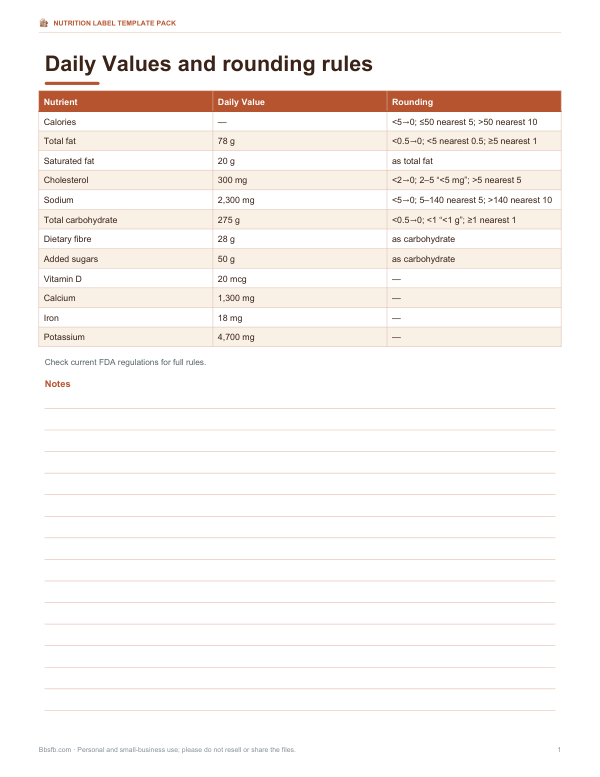
Free sample: Daily Values and Rounding (PDF, 126 KB)
Full refund within 7 days — see the refund policy and license.
Free printables
Single sheets you can print right now, no sign-up. The full pack adds every sheet in one download plus the editable files.
 Printable Food Label Checklist
How to make a Nutrition Facts label
- Find the nutrient content of one serving: from lab analysis, a nutrition database calculation based on your recipe, or supplier data.
- Decide the serving size. In the US, serving sizes are based on reference amounts customarily consumed (RACCs) set by the FDA for each food category, expressed in a household measure and grams.
- Enter servings per container, serving size and the amount of each nutrient per serving.
- Check the preview: the template rounds values and calculates % Daily Value.
- Print the label or save as PDF to send to your label printer.
The template follows the layout of the current US Nutrition Facts label introduced by the FDA in 2016, with bold calories, updated Daily Values, added sugars and the four required vitamins and minerals.
Rounding rules used
| Nutrient | Rule |
|---|---|
| Calories | Under 5 → 0; up to 50 → nearest 5; above 50 → nearest 10 |
| Total, saturated and trans fat | Under 0.5 g → 0; under 5 g → nearest 0.5 g; 5 g or more → nearest 1 g |
| Cholesterol | Under 2 mg → 0; 2–5 mg → “less than 5 mg”; above 5 mg → nearest 5 mg |
| Sodium | Under 5 mg → 0; 5–140 mg → nearest 5 mg; above 140 mg → nearest 10 mg |
| Carbohydrate, fibre, sugars, protein | Under 0.5 g → 0; under 1 g → “less than 1 g”; otherwise nearest 1 g |
| % Daily Value | Nearest 1% |
These are the core rounding rules from the FDA’s labelling regulations. There are further details — for example, rounding of vitamin and mineral values and specific rules for “0” claims — that a food business should check against the current regulations or with a labelling consultant.
Daily Values on the current label
| Nutrient | Daily Value |
|---|---|
| Total fat | 78 g |
| Saturated fat | 20 g |
| Cholesterol | 300 mg |
| Sodium | 2,300 mg |
| Total carbohydrate | 275 g |
| Dietary fibre | 28 g |
| Added sugars | 50 g |
| Vitamin D | 20 mcg |
| Calcium | 1,300 mg |
| Iron | 18 mg |
| Potassium | 4,700 mg |
Daily Values are reference amounts for adults and children 4 years and older based on a 2,000-calorie diet. Trans fat, total sugars and (usually) protein have no % DV on the label. Protein % DV is required only when a protein claim is made or the food is for children under four.
Where the nutrient numbers come from
- Laboratory analysis — the most accurate method; a food lab tests your product.
- Database calculation — add up nutrients of each ingredient from a nutrient database, adjusting for cooking losses and water loss; common for small producers.
- Supplier specifications — for single-ingredient foods or repacked products.
Whichever method you use, keep records. The template only formats and rounds the numbers you supply; it does not calculate nutrients from a recipe.
Who needs a Nutrition Facts label?
In the United States, most packaged foods sold to consumers need a Nutrition Facts label. There are exemptions — for example, some small businesses that meet sales and employee thresholds and file a notice with the FDA, foods sold directly by the maker in restaurants and bakeries, and foods with no significant nutrients such as plain coffee. Exemptions are lost if you make a nutrient or health claim. Check the FDA’s guidance for small businesses before relying on an exemption. Outside the US, rules and label formats differ: the EU, UK, Canada and Australia each have their own nutrition declaration formats.
Worked example: granola
A granola has a serving size of ⅔ cup (55 g) and about 8 servings per container. Per serving it contains 230 calories, 8 g total fat (1 g saturated), 160 mg sodium, 37 g carbohydrate with 4 g fibre and 12 g total sugars including 10 g added sugars, and 3 g protein. The label shows 230 calories, fat 10% DV (8 ÷ 78), saturated fat 5%, sodium 7%, carbohydrate 13%, fibre 14% and added sugars 20% DV. Vitamin D 2 mcg (10%), calcium 260 mg (20%), iron 8 mg (44%) and potassium 240 mg (5%) complete the label.
Printing the label
- Print at 100% on white label stock, or save to PDF and send to a label printer.
- Keep the label on the information panel or principal display panel of the package as required.
- Use black text on white or a neutral contrasting background.
- For small packages, simplified or tabular formats are allowed; the paid pack includes tabular and linear versions.
Uses beyond packaged foods
Home cooks, dietitians, teachers and food bloggers use Nutrition Facts templates to present recipe nutrition clearly, for class projects on reading labels, and for meal-plan handouts. For these uses, a label based on database calculations is a helpful summary; just note that the figures are estimates.
Limitations
This template produces the standard vertical format for a single serving. It does not produce dual-column labels (per serving and per container), aggregate labels for variety packs, or labels for infants and children under four, which have different Daily Values. It is not a compliance review: food businesses are responsible for accurate values and correct format under current regulations.
Frequently asked questions
Can I make a Nutrition Facts label for free?
Yes. Enter your nutrient values and print the label from this page.
Does the template calculate nutrients from a recipe?
No. It formats and rounds values you supply from lab analysis or a nutrient database.
Which label format is this?
The current US vertical format introduced in 2016.
Why does my label say “less than 1 g”?
FDA rounding rules require that wording for amounts between 0.5 and 1 gram.
Is the label legally compliant?
It follows the standard layout and rounding rules, but food businesses must verify values and format against current regulations.
Is my data uploaded?
No. Everything runs in your browser.